
// in this post
My first console was an Atari 2600. After that came a SNES, then an Amiga, a PlayStation, and for the last twenty years or so, mainly a PC. I still have a PS5 and an Xbox under the telly, but most of my games live on Steam, so when Valve finally put a price on its Steam Machine I was excited, and paid attention the way I always do. What I did not expect was that the price would send me reading about semiconductor wafers, high-bandwidth memory, and a squeeze that connects your next phone to the AI boom you keep hearing about.
The box is the easy part. The more interesting question is why it costs what it does, and what the answer says about almost everything else with a chip in it.
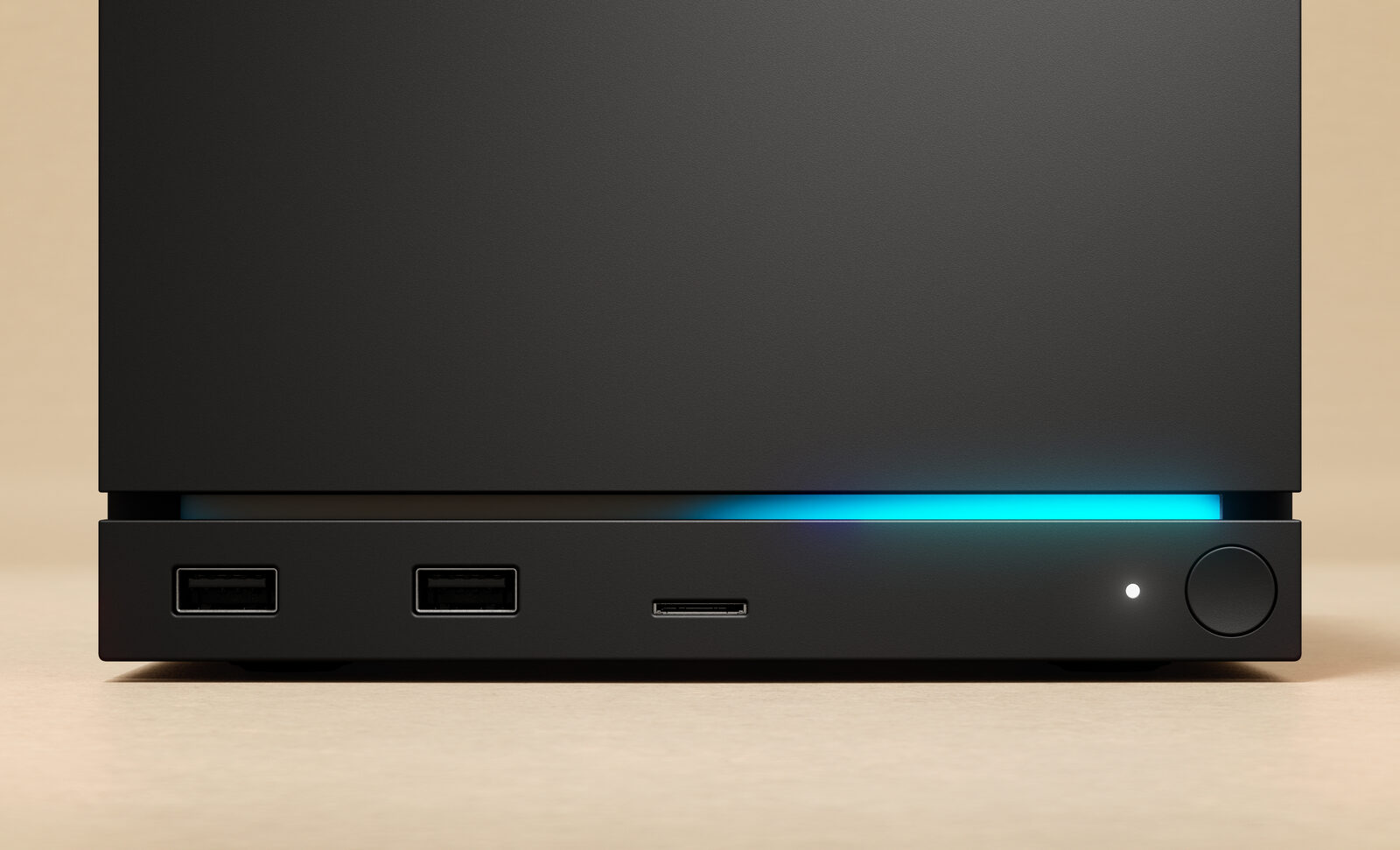 Valve's Steam Machine, a compact living-room PC, launches on 30 June 2026.
What Valve actually announced
The Steam Machine is Valve's living-room PC, a roughly 16cm cube running SteamOS 3, with Windows 11 as an option. It launches on 30 June 2026, with reservations opening on 25 June. Inside is a semi-custom AMD chip: a six-core, twelve-thread Zen 4 CPU paired with an RDNA 3 graphics part, 16GB of DDR5 system memory and 8GB of GDDR6 graphics memory.
The prices raised eyebrows. In the UK the 512GB model is £879. A 2TB version is £1,149, and a 2TB bundle with the Steam Controller is £1,208. For the performance on offer, that is a lot, and plenty of the coverage said so.
A machine like this would have been cheaper to build eighteen months ago. The reason it is not comes down to two of those components above: the DDR5 and the GDDR6. Memory has become one of the most expensive things in any computer, and the Steam Machine has arrived at the worst possible moment for it. Valve reportedly held the launch back from earlier in 2026 in part because of memory prices. The box is a symptom. The disease is much bigger.
The numbers: what happened to memory
Computer memory comes in a few flavours. DRAM is the working memory in your PC, phone and console. NAND flash is the storage in your SSD. Both have gone up in price at a pace the industry has not seen before. Commentators have taken to calling it "RAMmageddon", which tells you something about the mood.
The figures vary by source and by the exact period measured, so treat them as a range rather than a single number. By some measures DRAM prices rose around 170% across 2025. They then climbed again in early 2026, with analysts at TrendForce and Counterpoint Research reporting further quarter-on-quarter rises somewhere between 50% and 90%, depending on the chip and the contract. Specific DDR5 modules more than doubled at retail, and in some Tokyo electronics shops the increases were sharp enough that stores started limiting how much one person could buy. NAND flash jumped too, with contract prices up more than 60% month-on-month at one point in late 2025.
The clearest sign of how strange things have become: memory makers have reportedly moved parts of the market to something close to hourly pricing, and HP told investors that memory now accounts for around 35% of the bill of materials for a PC, up from 15% to 18% not long ago. A third of the cost of a computer is now the memory inside it.
The cause: this one is AI
Hardware shortages usually have a familiar villain: a factory fire, a pandemic, a shipping snarl. This one is different, and it is worth being precise about why, because the cause is the same thing this site spends most of its time on.
The shortage is structural, and it is being driven by artificial intelligence. Training and running large AI models needs enormous quantities of memory, particularly a specialised, expensive type called high-bandwidth memory, or HBM, which sits next to the chips in AI data centres. HBM uses far more manufacturing capacity per unit of memory than the ordinary DRAM in your laptop. So when the three companies that make most of the world's memory, Samsung, SK Hynix and Micron, shifted their factories toward HBM to feed the AI build-out, the supply of normal consumer memory shrank.
The scale is hard to overstate. By 2026, data centres are estimated to consume around 70% of the world's memory chips. The big cloud companies, Google, Amazon, Microsoft and Meta, have reportedly placed open-ended orders, agreeing to take supply more or less regardless of cost. OpenAI's Stargate infrastructure project struck deals with Samsung and SK Hynix that, by some reporting, could consume up to 40% of global DRAM output on their own. When buyers like that will pay anything, a gaming PC does not stand much of a chance at the front of the queue.
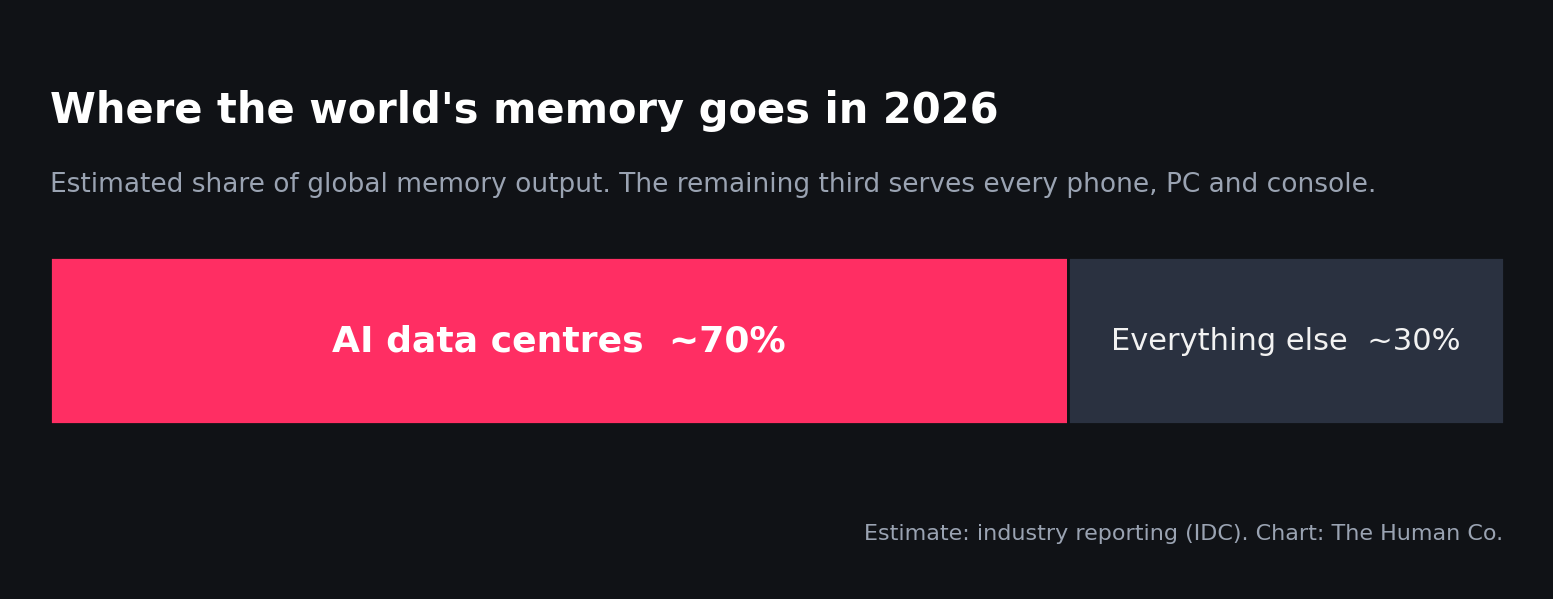 Estimated share of global memory output in 2026. Source: industry reporting (IDC).
This is the part I keep coming back to. The AI boom is not an abstraction happening in a server farm somewhere. It is reaching into the supply chain for ordinary electronics and pulling the components out. The cost of the AI supercycle is, quite literally, showing up in the price of a games console.
Where it bleeds: phones, PCs and consoles
The Steam Machine is one visible example because it is new and it is trending. But the squeeze is everywhere memory is, which is to say everywhere.
Phones. Your smartphone is stuffed with DRAM and flash. Analysts expect average smartphone prices to rise by around 14% in 2026, with global sales forecast to fall (estimates range from roughly 8% to 13%) as a result. Samsung, which makes both phones and the memory inside them, has warned that price rises are coming across its range. CNBC went further, reporting that the crisis has hit "such extremes that even Apple cannot be safe", notable because Apple had locked in long-term memory supply deals and was thought to be insulated. When the most powerful buyer in consumer electronics is exposed, everyone below it is too.
PCs and laptops. Major vendors including Lenovo, Dell, HP, Acer and Asus have signalled price increases of 15% to 20% from the second half of 2026. Gartner has forecast the worldwide PC market shrinking by around 10% in 2026. Most strikingly, some analysts suggest entry-level laptops under about £400 could become commercially unviable within a couple of years, because the memory alone would eat the margin. Dell's chief operating officer, Jeff Clarke, said in late 2025 the company "had never witnessed costs escalating at the current pace". Lenovo's finance chief called the surge "unprecedented".
Consoles. This is no longer about manufacturers quietly absorbing costs. They are passing them straight on. Sony has raised PlayStation 5 prices twice in under a year, with both the standard console and the Pro going up again in 2026. Microsoft has done the same with the Xbox Series X and S, more than once. Valve put the Steam Deck's price up by around 46% on some configurations, and it still sold out. The Steam Machine arrives into exactly this: priced for what memory now costs, not for what any of us would like to pay.
And it does not stop at memory. SSD prices have roughly doubled in places, hard-drive supply for 2026 was booked out early, and even CPU prices are expected to rise as fabrication capacity is prioritised for servers.
How long, and what breaks the cycle
Not soon. SK Hynix's leadership and analysts at Kearney both point to the shortage lasting until around 2030, with wafer supply trailing demand by roughly 20%. More optimistic estimates put some relief in late 2027. Micron, tellingly, retired its consumer-facing "Crucial" memory brand, a sign of where it sees the money, and it is not in your desktop.
There is one wildcard here, and it is also AI. In March 2026, Google announced a memory-compression technique it calls TurboQuant, claiming it can run large language models with several times less memory. If techniques like that take hold, they could soften AI's appetite for memory from the demand side rather than the supply side. Memory-maker share prices wobbled on the news, which tells you the market takes it seriously. The thing driving the shortage may also, eventually, help end it.
What this means if you just wanted to buy something
If you are buying a PC, a phone or a console in 2026, you are buying into a seller's market for memory, and prices reflect it. A few practical things follow from that. If you need the hardware now and the spec is right, buying sooner rather than later is defensible, because the trend through 2026 is up, not down. If you can wait, the relief is more likely to come from next-generation efficiency and software than from a sudden flood of cheap memory, so do not hold out for a 2023-style bargain that may not return for years. And if you are choosing between configurations, the memory tiers are where the cruel maths lives now: that jump from 512GB to 2TB on the Steam Machine is, in part, the shortage priced in.
There is a bigger lesson too, and it is the one I find most interesting. We tend to talk about the cost of AI in terms of energy, jobs or subscriptions. This is a reminder that it also has a physical, industrial cost, and that cost is rivalrous. Every wafer turned into high-bandwidth memory for a data centre is a wafer that did not become DDR5 for a games console. The AI build-out and your shopping basket are now drawing from the same well.
There is a quieter effect too, on trust. AI already meets plenty of scepticism at work, and people who feel wary of it now have one more reason: it is quietly making the things they buy more expensive. When a technology's costs reach your shopping basket before its benefits reach your job, willingness to engage with it takes a knock. That is part of why so many AI rollouts stall, and the visible price of the boom does not help.
For a business planning its own AI investments, that supply reality is worth understanding: the hardware layer is constrained, expensive, and likely to stay that way for years.
I came for a Steam Machine. I left with a much clearer picture of why everything with a chip in it is about to cost more. Funny how that works.
FAQ
Why is RAM so expensive in 2026?
Because AI data centres are consuming most of the world's memory supply. The companies that make memory, Samsung, SK Hynix and Micron, have shifted production toward high-bandwidth memory (HBM) for AI, which uses far more factory capacity per unit, shrinking the supply of ordinary consumer DRAM and pushing prices up sharply through 2025 and 2026.
Is the Steam Machine expensive because of the RAM shortage?
Partly. The Steam Machine is a full PC with 16GB of DDR5 and 8GB of GDDR6, and memory now makes up around a third of a PC's build cost. It launched at £879 to £1,208 into a market where memory prices have risen sharply, and Valve reportedly delayed it in part because of those costs.
Will phone and PC prices go up because of the memory shortage?
They already are. Average smartphone prices are forecast to rise around 14% in 2026, and major PC makers have signalled 15% to 20% increases from the second half of the year. Even Apple, which had secured long-term supply, is reportedly exposed.
What is causing the global memory shortage?
AI. The demand for memory in AI data centres, led by hyperscalers like Google, Amazon, Microsoft and Meta and projects like OpenAI's Stargate, has outstripped supply, with data centres estimated to use around 70% of memory produced in 2026.
When will memory prices come back down?
Most forecasts point to the shortage lasting until around 2030, though some see partial relief by late 2027. Memory-saving software like Google's TurboQuant could ease demand sooner, but a return to 2023 prices looks unlikely in the near term.
Sources
- Global memory supply shortage, 2025 to present, Wikipedia. Overview, timeline, and the DRAM, HBM and OpenAI/Stargate figures.
- Memory crisis hits such extremes that even Apple can't be safe, CNBC, 19 June 2026. The Apple and consumer-impact angle.
- BBC News. Further coverage of the consumer price impact.
- AI Boom Fuels DRAM Shortage and Price Surge, IEEE Spectrum, and analyst forecasts from TrendForce, Counterpoint Research, IDC and Gartner via industry reporting. Price-rise and market-decline figures.
- Steam Machine pricing and specifications: GameSpot, Engadget, and UK pricing via TheSixthAxis.
- 2026 console price increases: Sony PlayStation.Blog and CNBC on the PS5; Xbox and Steam Deck increases via industry reporting.