
// in this post
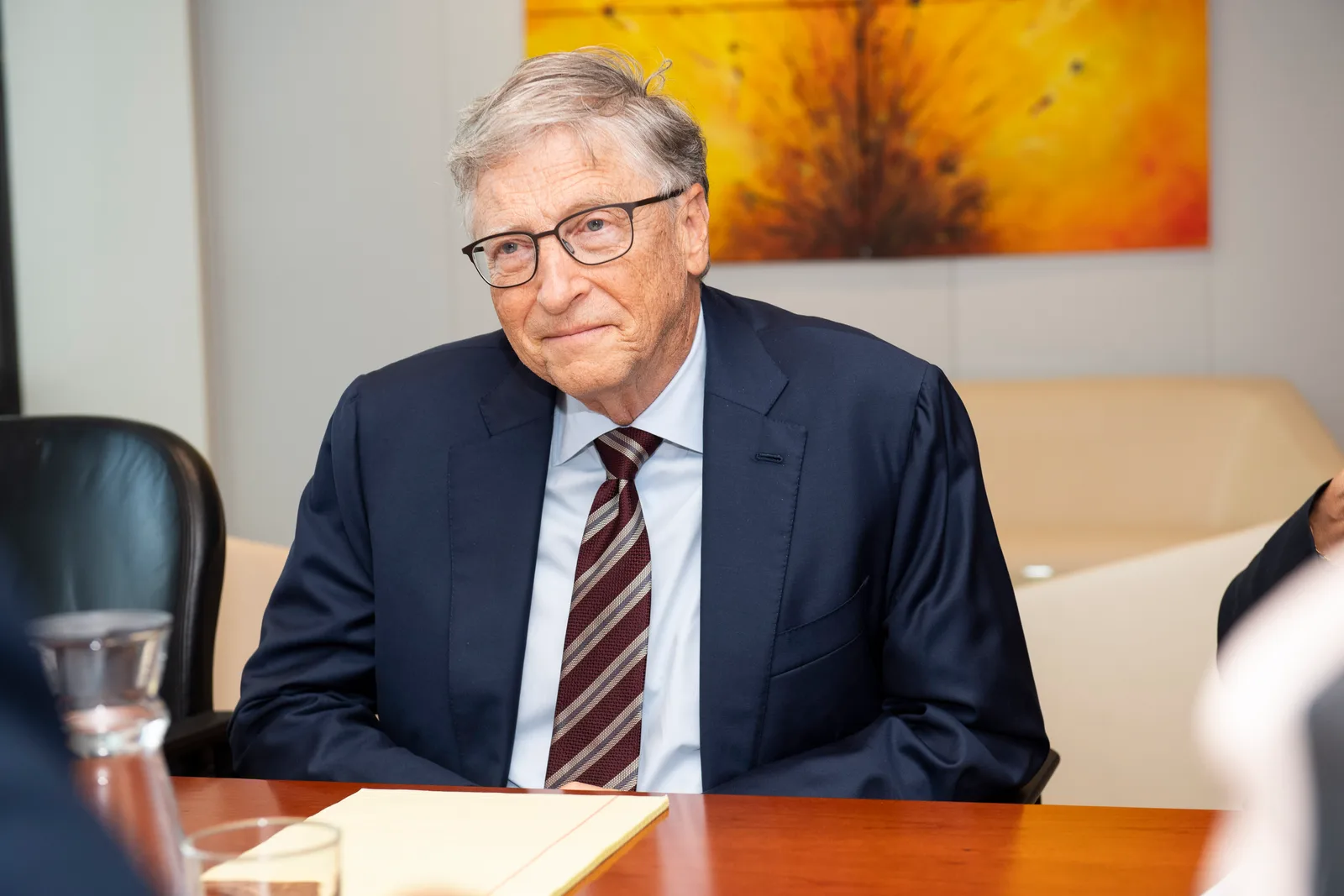
Bill Gates spent March 2023 telling the world that AI was as revolutionary as the personal computer, and that the biggest risk was moving too slowly to put it to work on poverty and disease. This week he told the New York Times that addressing AI's dangers should be "the world's top priority", that mass job losses are inevitable without intervention, and that the industry knows this and is hiding it because there's too much money on the line. In private, he says, people who understand how good the technology is getting are "very worried." In public, colleagues tell each other: "Don't say that. It's bad for us, the next trillion dollars we're trying to raise."
I don't think Gates is wrong that trust has collapsed. I think he's largely right about why. Where I part company with him is on what happens next, and it matters for anyone running a business, because the two questions get treated as the same one when they're not.
A Manufactured Crisis of Trust
The industry has spent three years building bigger models and almost no time building trust. Public messaging from AI leaders has swung erratically between wild hype and existential doom, often in the same week. Meanwhile, data centres are appearing across the US and UK with nearby communities given no notice until the concrete trucks arrive. This isn't a failure of technology, it's a communication collapse on a scale that makes traditional PR advice about "bringing people along" seem laughably inadequate.
In the nearly 6,000-word essay behind his interview, Gates lists five specific thresholds the industry originally claimed would justify slowing down: lowering the bar for bioweapons or cyberattacks, reshaping human relationships through AI companions, mass labour disruption, and loss of meaningful system control. His core point is simple: the industry is currently breaching the exact guardrails it once promised to respect.
When a survey I wrote about a few weeks ago finds that clients trust AI-prepared work less the more of it they've actually seen, or that most people reject an AI-assisted report outright, the scepticism makes complete sense. Nobody has been given a compelling reason to trust this trajectory. You don't get to bypass earning public confidence just because the underlying engineering is extraordinary. Gates' reference to colleagues warning "don't say that, it's bad for the next trillion dollars we're trying to raise" captures the rot. That isn't corporate caution. It's an explicit statement of priorities, and user comfort isn't on the list.
Gates isn't alone in calling this out. Dario Amodei, whose company built the tool that pretty much runs my own business, called the backlash "fundamentally a crisis of trust" this month, noting that "ordinary people don't trust companies, governments, or the tech industry and always suspect that we are cooking up some new way to screw them over."
He went further than most leaders would: "the most accurate criticism of AI companies including Anthropic is that we haven't yet delivered on our big promises to benefit the world." When founders themselves call out their own BS you know things must be bad.
The Missing Factor: Human Resistance
Having used these tools daily since ChatGPT launched in late 2022, I've seen the shift firsthand. Watching Claude Code build an e-learning authoring tool I'd sketched out for months, from a single conversation, in an afternoon, was a genuine turning point. Yet despite working with this tech constantly, I remain unconvinced that the mass unemployment Gates now treats as inevitable will unfold the way he describes.
The primary driver behind this growing anxiety is the transition from passive chatbots to autonomous agents. A model that answers a query is unsettling; a model that independently builds systems while you go make yourself a cup of tea changes the equation entirely.
However, capability forecasts consistently leave out a critical variable: adoption is gated by human cooperation as much as technical capability. Human beings naturally seek meaning, agency, and purpose in their work. When a technology attempts to eliminate that human element, whether in the office or through frictionless AI companions that demand nothing of us, it triggers deep personal and organisational resistance.
If people refuse to work alongside these systems, deployment stalls long before technical limits are reached. Gates is right that AI threatens to stunt human relationships by eliminating friction, but that same friction is precisely why people will resist being automated out of the loop.
Don't believe me, just ask your Gen Z colleagues what they really think of AI.
Practical Strategy for Business Leaders
If you're running a business, the practical lesson here isn't about calculating token taxes or deciding which roles to designate as "human reserved." It's about avoiding the mistake made by Gates and the tech industry at large: assuming you know what your people think, only to discover you were wrong at scale.
Most organisations struggle with internal communication under normal conditions. Under pressure, executive teams default to building a plan in isolation, announcing it, defending it, and repeating the cycle. Do the opposite. Sit down with your workforce before finalising your AI strategy to identify their actual worries rather than your assumptions. Addressing real fears upfront is slower, but it's the only approach that doesn't require a damage-control campaign three years down the line.
The Uncomfortable Truth Test
One detail in the interview stands out. Gates conceded he might be an imperfect messenger given his wealth and Microsoft's track record, noting: "I don't like bringing bad news to people, and I don't like saying that innovation may be a net negative. But that's where we are."
That willingness to deliver uncomfortable truths plainly, including about oneself, marks the divide between leadership worth trusting and leadership that isn't. Although I will concede it's difficult to trust leaders who have themselves been mired in their own controversies. However, Gates' heel turn on AI contrasts sharply with an industry whose internal instinct is to stay quiet because transparency threatens the next fundraising round. If you need a framework for evaluating AI leadership or building your own organisational policies, that is the standard to apply.
FAQ
Has Bill Gates changed his mind about AI risks?
Yes, substantially. In March 2023 his essay 'The Age of AI has begun' framed AI almost entirely as opportunity, comparing it to the PC and the internet, with a short section on risk that called job losses manageable and runaway AI 'no more urgent' than before. In an August 2026 interview with the New York Times, he called addressing AI's dangers 'the world's top priority', said mass unemployment was inevitable without intervention, and accused the industry of knowingly downplaying the risks.
Why don't people trust AI companies?
Because trust has to be built and the industry has spent its effort elsewhere. Gates himself said colleagues privately tell each other not to admit their worries because it's 'bad for us, the next trillion dollars we're trying to raise.' Add erratic public messaging and infrastructure like data centres landing in communities with no consultation, and the distrust in the surveys isn't a mystery. It's the predictable result of how the industry has actually behaved.
Will AI cause mass unemployment?
Capability forecasts assume it will if left unaddressed, which is Gates' current position. The counter-argument is that adoption itself depends on people being willing to work with the technology, and human resistance is a real force that pure capability forecasts tend to ignore. If a workforce won't cooperate with how AI is being introduced, it doesn't get adopted at the scale the doom scenarios require, regardless of what the technology can technically do.
What is Bill Gates' token tax proposal for AI?
A tax on AI compute usage, designed to make it more expensive to replace a person with AI and to fund support for anyone who loses work as a result. It's one of several concrete policy mechanisms Gates proposed in 2026 that had no equivalent in his 2023 essay, alongside 'Human Reserved' job categories legally protected from automation and mandatory international review for any AI system that could be weaponised to design pathogens.
What should CEOs do to build trust in their AI rollout?
Do the opposite of what the industry has modelled. Sit down with your own people and find out specifically what they're worried about, rather than assuming you know or broadcasting reassurance before you've listened. Build the AI strategy to answer those actual concerns. Announcing a plan and defending it afterwards is the approach that produced the distrust in the first place.